
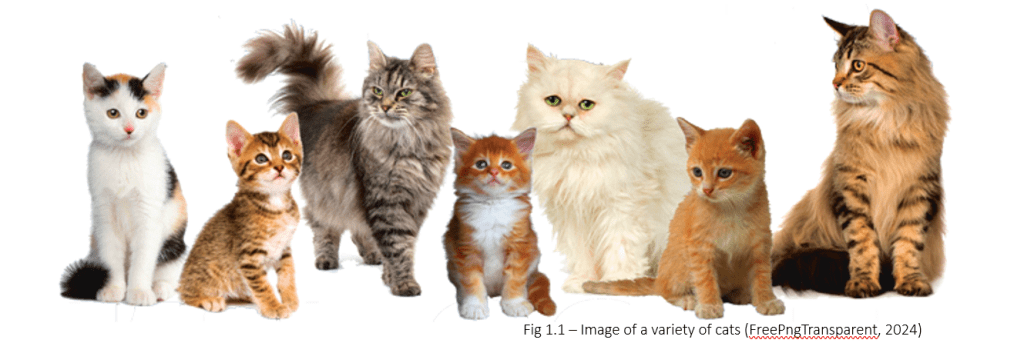
Are cats truly domesticated? It is something that is often pondered amongst humans as some seem to be whilst others are not (Ralls, 2024). How do humans really know? Is it the way cats look, behave or genetics? But most of all, what on earth is domestication?!
Domestication – Societies language of owning
According to Merriam-Webster (2023) domestication is officially defined as “the adaptation of a plant or animal from a wild or natural state to live in close association with humans”. This has what has connected humans to animals for more than 30,000 years (Boehringer Ingelheim, 2020). Considering this, it is often assumed cats belong in this category, as they are often equally part of humans lives alongside dogs, due to being beneficial for wellbeing (González-Ramírez, and Landero-Hernández, 2021).
However, cats are referred to as semi-domesticated, due to not being “completely brought under human control” (Cambridge Dictionary, 2024). When examining their history, unlike dogs where various breeds were formed to assist humans (Anthes, 2022), cats were exploited to work for humans, but not officially tied to them or altered to assist them (Daly, 2019), which are supported by archaeological discoveries and genome-sequencing studies. According to Ferris Jabr (2015) in 2004 a 5,300 year old settlement in China was discovered, whereby a cat was unearthed and analysed discovering it ate rodents, grains, and leftovers of human meals. Further studies revealed, it was living near settlements that were close to farm land and grain stores, where mice and rats were rife, but the cat was physically not housed with them.
Genetics – A lot more than just a cat
Conversely, beyond archaeological studies, genetics have assisted in discovering not only their semi-domestication but also their ancestorial link. Gaia Remerowski (2014) confirms that geneticist professor Wes Warren, at The Genome Institute, found that they only recently “split off from wild cats, and some even still breed with their wild relatives”. Moreover, due to their semi-domesticated nature, and their breeding habits, humans have not necessarily been able to fully convert cats to domestication, unlike dogs. Or have they?
Survival – Will cats forever be semi-domesticated?
Considering both historic events and genealogy, does this mean that cats are forever destined to have a paw both with humans and their own kind? According to Christian Adams (2023) this seems to be the case, as they “choose to spend time with humans when they’re perfectly capable of living on their own”. In addition, there are millions of unowned cats worldwide whether they be strays, which were previously household cats, or ferals, who are truly independent and have never been historically owned (Adams, 2023).
On the other hand, Driscoll et al., (2009) doesn’t believe it will be long until they reach full domestication. Apparently, cats are “only just” treading their paw into this territory, due to society pushing domesticated cats’ genetics into unknown territory. Hybridisation. For instance, the Bengal was created by crossing a house cat with an Asian Leopard. If this method continues with other breeds radical evolution could occur creating multiple species that are more reliant and tied to humankind (Driscoll et al., 2009).
Conclusion
In conclusion, cats have historically been exploited to be part of society, but have still had some choice as to whether they wish to continue as part of the human world. Even genetics have revealed they still breed with wild cats, still having a paw in either world. However, whether or not cats continue to make the choice to be a part of the human world or not, soon humans may force their paw and have the collar permanently around their neck.
References
Adams, C. (2023). Could Cats Survive in a World Without Humans? Feline Independency Facts. [online] Catster. Available at: https://www.catster.com/guides/could-a-cat-survive-in-a-world-without-humans/ [Accessed 24 April 2024].
Anthes, E. (2022). Brains, Brawn or Both: What Drove the Creation of Modern Dog Breeds? The New York Times. [online] 8 Dec. Available at: https://www.nytimes.com/2022/12/08/science/dog-breed-genetics.html. [Accessed 28 February 2024].
Boehringer ingelheim (2020). The human-dog relationship – a historical perspective. [online] Boehringer-ingelheim.com. Available at: https://www.boehringer-ingelheim.com/our-responsibility/animal-health-news/human-dog-relationship-historical-perspective#:~:text=There%20is%20archaeological%20evidence%20dogs. [Accessed 9 January 2024].
Cambridge Dictionary (2024). semi-domesticated. [online] @CambridgeWords. Available at: https://dictionary.cambridge.org/dictionary/english/semi-domesticated [Accessed 8 January 2024].
Daly, N. (2019). Domesticated animals, explained. [online] Available at: https://www.nationalgeographic.com/animals/article/domesticated-animals#:~:text=Animal%20domestication%20falls%20into%20three. [Accessed 8 January 2019].
Driscol, C.A., Clutton-Brock, J., Kitchener, A.C., and O’Brien, S.J. (2009). The Evolution of House Cats. [online] Scientific American. Available at: https://www.scientificamerican.com/article/the-taming-of-the-cat/.
FreePngTransparent. (2024). ᐅ143+ Cat PNG, Cat Png Transparent Images Download. [online] Available at: https://freepngtransparent.com/cat-png/ [Accessed 28 February 2024].
González-Ramírez, M.T. and Landero-Hernández, R. (2021). Pet–Human Relationships: Dogs versus Cats. Animals, 11(9), p.2745. doi:https://doi.org/10.3390/ani11092745.
Jabr, F. (2015). Are Cats Domesticated? [online] The New Yorker. Available at: https://www.newyorker.com/tech/annals-of-technology/are-cats-domesticated#:~:text=The%20latest%20answer%2C%20based%20on [Accessed 8 January 2024].
Merriam-Webster.com. (2023). Definition of DOMESTICATION. [online] Available at: https://www.merriam-webster.com/dictionary/domestication#:~:text=do%C2%B7%E2%80%8Bmes%C2%B7%E2%80%8Bti. [Accessed 8 January 2024].
Ralls, E. (2024). Are Cats Domesticated? [online] Available at: https://www.earth.com/earthpedia-articles/are-cats-domesticated/ [Accessed 24 April 2024].
Remerowski, G. (2014). The cat’s meow: Genome reveals clues to domestication – The Source – Washington University in St. Louis. [online] The Source. Available at: https://source.wustl.edu/2014/11/the-cat-meow-genome-reveals-clues-to-domestication/#:~:text=%E2%80%9CCats%2C%20unlike%20dogs%2C%20are [Accessed 28 February 2024].


Leave a Reply