
Sadly, this is another personal article, and like the previous, one I wish I didn’t have to write. However, I do firmly believe that if I didn’t write this, I wouldn’t be doing my service to you pet lovers out there!
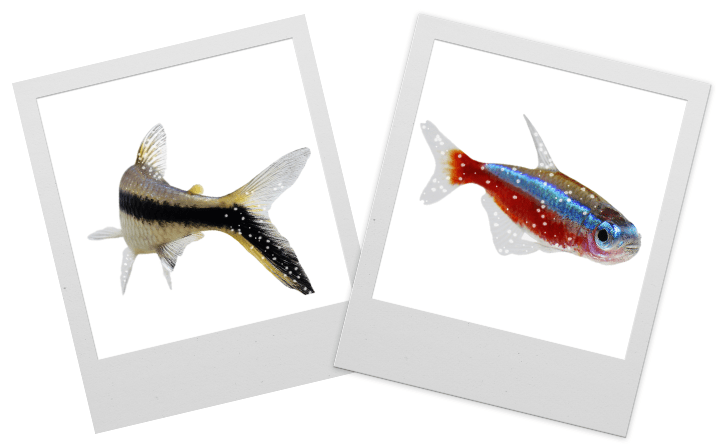
According to The Ornamental Aquatic Trade Association, in the UK alone, it is estimated that 12 million households own a pet, of which 4 million or 14%, own an aquatic (2017). We are one of those households, who had cardinal tetras, yellow tiger & white Moscow guppies, red cherry barbs and even some cherry red shrimp to clean up the surface. This also made Dippy, now our only cat, really happy. She loves having little fish friends and has always been kind to those smaller than her. She even used to bump noses with my blind hamster every time she saw him and purred. So having fish was like having her own personal tv on tap.
Unfortunately, we have lost our fish friends to an awful disease, white spot, which sadly is very common in freshwater aquatics (Xu, 2014), but to me it was the most traumatic thing to see in any animal, and something I don’t wish to ever repeat.
What on earth is white spot?
White spot, commonly known as ich disease, is caused by a ‘ciliate protozoan’ (Xu, 2014), which form an extremely large group and are the most complicated out of the protozoan family (Horan, 2003). Protozoans are a specific type of one-celled organisms similar to bacteria, but they also contain a nucleus and other structures which make them more related to plant or animal cells (Durani, 2024).
When fish are infected with the ich (which also gives me the ick personally) they develop small, blister raised lesions on the skin or fins. Although it can also be restricted to just the gills, meaning there are no visible signs of the disease being present (Xu, 2014). The disease is highly contagious, and spreads from one fish to another especially in crowded tanks and progresses more quickly in warm temperatures. To make matters worse when you see it with the naked eye the fish are in or nearing the last cycle of the disease, and seriously ill. In addition to this, depending on the volume you can see the disease, euthanasia may be the only, and kindest, option (Francis-Floyd, Pouder & Yanong, 2024).
Furthermore, due to the nature of the disease, it has a high mortality rate (Xu, 2014), meaning they die in a few days (Aquaforest, 2023). Which doesn’t provide much time to attempt to cure the fish of the disease either.
What causes the disease?
Well, this is where things become very tricky, as there can be multiple causes as to how.
The first common cause, is introducing fish that are currently carrying white spot, meaning they are infected with it to begin with. Another cause can be introducing the water from another tank, for instance. These common causes can easily be done when buying the fish from a local aquarium shop or directly from the breeder themselves who haven’t done a thorough check of their supply, quarantined newly acquired fish within their tanks before allowing them to join their selling tank, or worse not cleaned their tanks and water if disease was previously present (Aquarforest, 2024)!
Alternatively, it can be due to purchasing used equipment and not having it disinfected before placing it into the aquarium. Additionally, knowing the water quality before placing the fish into the aquarium is a must, as it alters the fish immune system making them more susceptible to diseases, and if this isn’t taken care of correctly can develop the disease (Aquarforest, 2024).
Unfortunately, in our case it was due to the local aquarium shop we bought the fish from, as our original supply of fish from another shop were completely fine and shown no signs of the disease, and yes we did check their gills! Due to the loss of the fish, we had to completely clean and sterilise our equipment and tank, remove the substrate, live plants and decorations to be ultra safe, as well as remove the water. Which as you can guess is not only heartbreaking to remove those previous fish friends, but expensive to replace everything that we had purchased too.
However, to me this was unacceptable for a shop to sell us fish that had this disease, therefore when I made the complaint I explained to me this was against the animal health and welfare act, and because of the great distress of what occurred, that we needed to be compensated. Luckily the shop agreed to do this, even offering us new fish…but I’m sure you can guess what my response was to that.
“Prevention is better than cure”
As they always say “prevention is better than cure” (Royal College of Nursing, 2024), so how do we prevent this from happening to your fish? The first most important thing is to make sure any new fish are quarantined for 4 to 6 weeks before putting them in your tank, this also extends to new plants as well, which can take 2-3 weeks. If you want to speed up this process, then you can increase the temperature of the tank, but then that puts them under stress which could cause the disease that way!
This leads to the next important prevention technique, don’t stress them out! This is because like humans, it lowers their immune system making them vulnerable to diseases. Stress can be caused be due to improper diet, too much or too little water flow and even poorly adjusted water parameters (Aquafresh, 2024).
In conclusion…
Overall, white spot is an awful disease, and yes it can be very common in aquatics, but these fish like every other mammal, avian and reptilia in the animal kingdom, deserve to be protected and looked after the best they can be. So prevent white spot from occurring if you can, because these fish deserve to have the best care they can. We couldn’t protect ours, but you definitely can.
References
Aquaforest. (2023). Treat ich on fish – understanding, treating, and preventing white spot disease [online] Aquaforest. Available at: https://aquaforest.eu/en/articles/treat-ich-on-fish-understanding-treating-and-preventing-white-spot-disease/#:~:text=How%20quickly%20can%20Ich%20kill [Accessed 28 June 2024].
Durani, Y. (2024). Germs: Bacteria, Viruses, Fungi, and Protozoa (for Parents) – Nemours KidsHealth. [online] Available at: https://kidshealth.org/en/parents/germs.html#:~:text=Protozoa%20(pro%2Dtoe%2DZO. [Accessed 28 June 2024].
Francis-Floyd, R., Pouder, D., Yanong, R. (2024). Ichthyophthirius multifiliis (White Spot) Infections in Fish. [online] Available at: https://edis.ifas.ufl.edu/publication/FA006. [Accessed 28 June 2024).
Horan, N. (2003). Protozoa. Handbook of Water and Wastewater Microbiology, pp.69–76. doi:https://doi.org/10.1016/b978-012470100-7/50005-4.
Royal College Of Nursing (2024). Prevention is better than cure | Campaigns | Royal College of Nursing. [online] The Royal College of Nursing. Available at: https://www.rcn.org.uk/get-involved/campaign-with-us/prevention-is-better-than-cure#:~:text=The%20phrase%20. [Accessed 1 July 2024].
The Ornamental Aquatic Trade Association. (2017). Pets in Society. [online] Available at: https://ornamentalfish.org/what-we-do/represent-the-industry/pets-in-society/. [Accessed 28 June 2024].
Xu, De-Hai. PHD. (2014). How to Prevent Ich on Fish | Tropical Fish Hobbyist Magazine. [online] Available at: https://www.tfhmagazine.com/articles/freshwater/preventing-ich-full-article#:~:text=White%20spot%20disease%20is%20a%20very%20common%20problem%20in%20freshwater%20aquarium%20fish. [Accessed 28 June 2024].
 The Writing Tail
Leave a comment