

This is something that has been discussed at length by various individuals, causing debates, disagreements and other questions leading to various other issues. But why am I choosing to discuss this topic, when others seem to argue and fight over which is the correct answer? To answer that question, I need to give you some context into my fluffy animals.
Snowy – 19 years old, and trouble
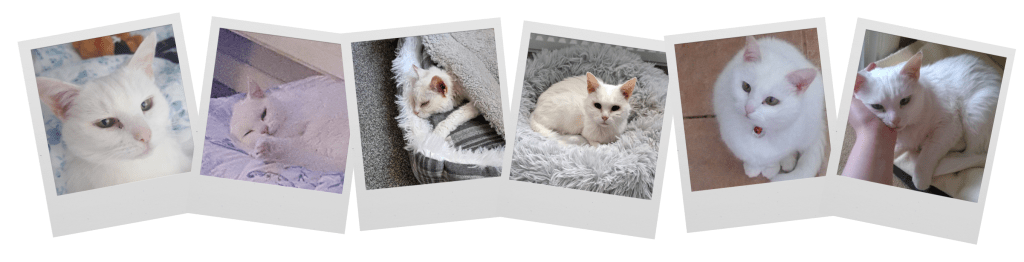
Meet Snowy, our families deaf, 19 year old white moggie, or commonly known as a domestic shorthair. You’ve most likely seen her around my website, Facebook and even Instagram or X adverts. She’s had kidney failure since she was 9, previously had a biological sister who was half blind in one of her complete heterochromia (that’s a posh word for multi-coloured) eyes and is addicted to Chinese food to the point she will climb on your lap just to get a lick. She has got into more scrapes than I can honestly count, including getting stuck up a tree, and rather than climbing down…she chooses to climb up, notices she’s even higher now and cries louder. If she was human, she would honestly be a female version of Uncle Albert from the sitcom “Only Fools & Horses”, lovable, talks about what she used to do in the war, and also trying to be smarter than she actually is (sometimes). But what has this lovable girl got to do about grief?
Unfortunately, earlier this year we lost her to an overactive thyroid, but in fairness to her she had so many other health ailments that were stacking up against her too. She had a tumour on her head, dementia, and arthritis. She was over 76+ in human years, so for a cat of that age, and those health ailments, she had done unbelievable. However, we knew it was time by the look in her beautiful emerald eyes, and it was really peaceful. No rushing like you usually see on an episode of Noel Fitzpatrick, we all got to spend a final day with her, giving her cuddles, love, and telling her whatever we wanted…even if she couldn’t hear us, we believe she felt our words through our hearts. We even had a final Chinese takeaway in her honour.
However, we weren’t the only ones losing her…
Dippy – 9 years old and is such a kitten
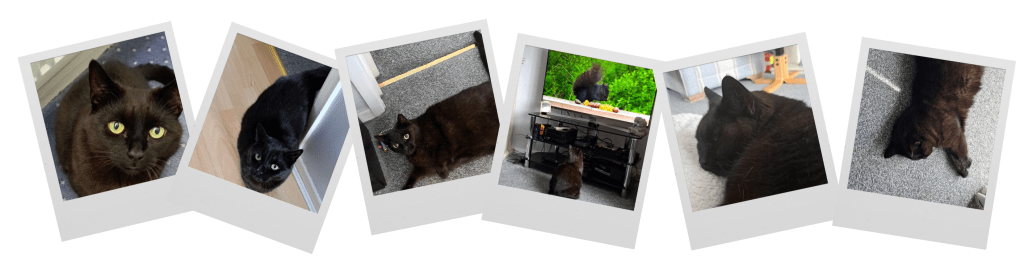
Meet Dippy, our 9 year old ragdoll cross, being mostly black and brown with a white tip on her tail (hint, that’s partially why we called her Dippy). She loves wotsit crisps, but they have to be the giant version because bigger is better, loves playing with a tape measure, and if she was a human, unlike Snowy she would be diagnosed with OCD and anxiety. Everything has to be the same, otherwise she will pounce on your head and purr in your ear until you get up and feed her at 5:30am. If we leave the house she waits by the door until we come home. Honestly, she’s probably more dog than cat but we couldn’t imagine a world without her.
Now, I’m not going to provide this perfect picture I’m afraid of Snowy and Dippy’s relationship. Snowy fought Dippy the second she came into our lives. She was not thrilled to have an adoptive sister, she didn’t like sharing, at all. Every time Dippy laid in a certain spot in the sun, Snowy wanted it, and usually got it if she hissed loud enough. When Dippy was a kitten, she ate Snowy’s original food, before being place on renal. So it wasn’t the greatest start.
However, after time they created a routine. For example, Dippy would eat her breakfast in the kitchen with Snowy every morning, without fail. On Saturdays when we laid in bed until late reading a book, Dippy would lay on my bed, Snowy on my parents. During late night tv watching, Snowy would be in her bed next to the radiator, whilst Dippy laid on the sofa with us, but they’d swap occasionally…although Dippy wouldn’t lay in Snowy’s bed because being the lovable old lady she was, she’d leak urine, and Dippy being the OCD girl she is, has too high standards to lay in a bed with a urine leak. So when considering all this, you’d think they wouldn’t miss each other, right? It’s just learning to navigate each other without causing any fights.
Grief – the unwanted visitor
Well that wasn’t the case. When we brought Snowy home for one final time, we had to consider Dippy and how she would be, and what to do after. The vet advised us to leave Snowy in her carrier and allow Dippy the opportunity to either visit her, or not. Cats can be fickle, sometimes they want to see them, other times not so much, and we had no idea how Dippy would react. Being a black cat, she is one of the most highly intelligent cat breeds, and when Dippy knows how to open doors, we knew she wasn’t stupid, so we was hoping she may have figured it out for herself. Therefore we came home, all crying, and dreading getting there to see how Dippy would react.
When we arrived we slowly greeted Dippy, who was at the door as always. We gently placed Snowy in the carrier in the lounge and sat there waiting for Dippy. She followed, reached the carrier and was sniffing. We opened the door to see what she would do, as she seemed like she really wanted to go in. She sniffed again, almost as if she was checking if she was right in her thought process and done something I’d never seen her do. She cried. She meowed as if she was crying. Not long after, she walked a few steps away, sat again and then sighed with her head down. It was something I had personally never seen first-hand in any animal. To see Dippy with her big eyes, head down like she was mourning with the rest of us, I honestly had no doubt in my mind about grief existing in animals.
Today, Dippy is sadly so sad with grief and stressed she has cystitis and an infection, which can be common in the realisation that a cat is now alone. But she’s getting better. Every day we stick close to the previous regime as possible, but also mix it up. We groom her every morning and play with her favourite tape measure day and night. We even put the tv on especially for her, and we’ve discovered she loves snooker as well as watching the birds and squirrels. Every day we cherish her.
What do the experts say about grief?
Unfortunately, this is something various individuals, groups and important figures agree and disagree on. For instance, Cats Protection have confirmed that it isn’t established whether cats ‘understand grief or not’ often behavioural changes are recognised when cats lose their companion. This can be changes in appetite, sleep patterns, and even in confidence. They even suggest that showing the cat who has been left behind the body, may not be as respectful as we humans are. But it isn’t confirmed that they even understand what death or grief is.
However, it isn’t just cats that potentially grieve in this way, dogs also do. According to VCA Hospital, dogs are very similar to humans in that their behaviour rapidly changes. It has been recognised they can become depressed suffering with mental health issues, moving more slowly and sulk. Although, they also agree that it is unknown whether they understand death either.
In connection with this, it’s not just cats that seem to show grief, as well as other household pets. David Attenborough even admitted he became tearful whilst viewing Elephants grieving over the bones of another Elephant. They even went as far as picking up the bones of the deceased with their trunks.
On the other hand, sceptics say otherwise. For instance, according to Emma Bryce ‘in order to grieve, an individual must first be able to understand the concept of death and their relationship with this inevitable force’, which clearly is difficult to prove in animals. Furthermore, they claim that seeing these behaviours in animals such as sulking, reducing or increasing appetite, may not be due to grief but more related to ‘stress or fear’.
However, others state that it is dependent on the animal itself. For example, Pete Wedderburn states that ‘the truth is that there is much variety in the way that animals are affected by loss. Some feel intense grief, and others don’t’. But then they also state that, animals can’t experience the five stages of grief directly, due to their forebrain not being large enough to go through the thinking parts of these aspects.
In conclusion…
Overall, its confusing for many to determine whether animals truly feel grief or not. Some theorize that they do, whilst others state they don’t. Although, both sides do seem to agree on one thing. That it can’t be confirmed either way, whether animals understand grief, or even what that emotion is.
Conversely, in all honestly, I personally don’t care whether the experts agree or disagree that animals experience grief. I know this isn’t a very balanced conclusion or being fair to the opposition and being objective, but it’s because I honestly believe I have seen it. If I could remove the memory like in “Harry Potter” and place it in a pensieve to show you what I’ve seen I believe you would agree with me too, regardless of whether you are an animal lover or not.
Unfortunately, I can’t do that. But I can ask this…
Do you believe animals feel grief?
References
Alonge, Jenny. (2024). Anxiety Disorders in Cats. [online] Available at: https://www.petmd.com/cat/conditions/behavioral/anxiety-disorders-cats. [Accessed 12 June 2024].
Bryce, E. (2022). Live Science. [online] 4 Sep. Available at: https://www.livescience.com/do-animals-grieve. [Accessed 12 June 2024].
Buzhardt, L., Hunter, T., Llera, R. (2023). Do Dogs Mourn | VCA Animal Hospital. [online] Available at: https://vcahospitals.com/know-your-pet/do-dogs-mourn#:~:text=When%20a%20dog%20loses%20a. [Accessed 12 June 2024].
Cats Protection. (2019). https://www.cats.org.uk/cats-blog/why-do-cats-have-different-coloured-eyes. [online] Available at: https://www.cats.org.uk/cats-blog/why-do-cats-have-different-coloured-eyes#:~:text=Although%20it. [Accessed 12 June 2024].
Cats Protection. (2024). Cats and fighting | Prevent cats from fighting. [online] Available at: https://www.cats.org.uk/help-and-advice/cat-behaviour/cats-and-fighting. [Accessed 12 June 2024].
Cats Protection. (2024). Grief in surviving pets | Do cats grieve? | Cats Protection. [online] Available at: https://www.cats.org.uk/what-we-do/grief/advice/grief-guidance-resources/grief-in-surviving-pets. [Accessed 12 June 2024].
Cornell Feline Health Center (2017). Hyperthyroidism in Cats. [online] Cornell University College of Veterinary Medicine. Available at: https://www.vet.cornell.edu/departments-centers-and-institutes/cornell-feline-health-center/health-information/feline-health-topics/hyperthyroidism-cats. [Accessed 12 June 2014].
Gardiner, R. (2018). Feline focus: The Domestic Shorthair cat. [online] MiPet Cover. Available at: https://www.mipetcover.co.uk/domestic-shorthair/ [Accessed 12 June 2024].
Hills. (2022). Signs That Your Cat is Grieving & How You Can Help. [online] Available at: https://www.hillspet.com/cat-care/behavior-appearance/do-cats-grieve [Accessed 12 June 2024].
Iams (2023). Calculating Your Pet’s Age in Cat Years. [online] http://www.iams.com. Available at: https://www.iams.com/cat/cat-articles/calculating-your-pets-age-cat-years [Accessed 12 June 2024].
Lewis, G. (2023). Only Fools and Horses fans are just realising Uncle Albert was totally ripped. [online] Digital Spy. Available at: https://www.digitalspy.com/tv/a45181865/only-fools-and-horses-fans-uncle-albert-ripped/ [Accessed 12 June 2024].
Mordasky, K. (2020). Do You Want More Pets Than You Need? [online] Hebron Veterinary Hospital. Available at: https://hvhct.com/blog/pet-care/do-you-want-more-pets-than-you-need/ [Accessed 12 June 2024].
The Herald. (2017). Sir David Attenborough on his tears over ‘grieving elephants’. [online] Available at: https://www.heraldscotland.com/news/15493894.sir-david-attenborough-tears-grieving-elephants/ [Accessed 12 June 2024].
Wedderburn, P. (2017). Do animals feel grief after suffering loss? [online] Available at: https://www.independent.ie/regionals/wicklow/lifestyle/do-animals-feel-grief-after-suffering-loss/35553033.html [Accessed 12 June 2024].
Wellness (2021). Black Cats: 6 Facts You Should Know. [online] Wellness Pet Food Master Brand. Available at: https://www.wellnesspetfood.com/blog/black-cats-6-facts-you-should-know/. [Accessed 12 June 2024].
 The Writing Tail
Leave a comment